A Clear Process for Managing Telegram Ads That Works
Managing Telegram Ads requires a hands-on process. You set the objective, fund the account in TON, write short text ads, choose relevant public channels, and monitor performance inside Telegram Ads. The platform runs on a minimum 0.1 TON CPM and only allows traffic to Telegram-based destinations, such as channels or bots.
There is no automatic bidding or external pixel tracking. Every adjustment, from targeting to budget changes, must be done manually. If you want steady growth through messenger marketing, you need a clear system and consistent oversight.
Keep reading for a step-by-step breakdown of how to manage it properly.
Process for Managing Telegram Ads
- Start with a defined objective and move step by step through setup, launch, and optimization, since Telegram Ads does not adjust bids automatically.
- Prepare your internal assets first. That means having a properly structured channel or a working chatbot in place before you send any traffic.
- Track joins and user actions yourself, since there is no external pixel tracking to do it for you.
What Is the End-to-End Process for Managing Telegram Ads?
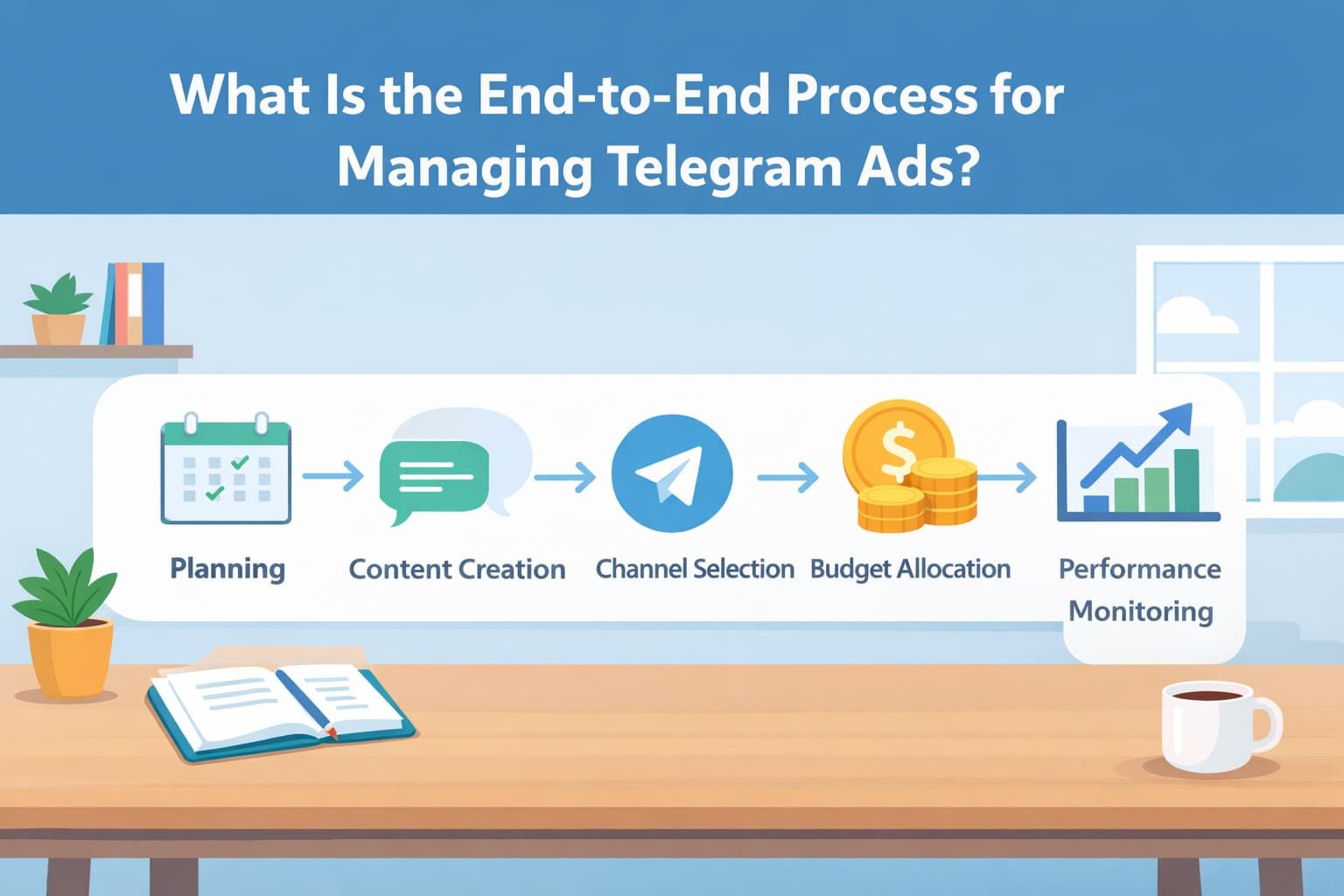
Managing Telegram Ads is a structured, manual process. We set clear goals, fund campaigns with TON (minimum 0.1 TON CPM), write short sponsored messages, choose specific channels, launch, monitor impressions, and adjust bids ourselves inside Telegram Advertising. During moderation, ads pass through a review stage described by Telegram as,
“In Review. Our team is currently checking the ad content before it can be displayed in channels.” - Telegram Ads documentation
This step shapes launch timing and requires planning ahead for approval delays.
Telegram Advertising runs as a self-serve system. We log in with a phone-verified account and create an Organization that holds the budget and owns the ads. Campaigns are funded in TON, and impressions are charged on a CPM basis.
The process starts with defining a KPI, whether tracking channel joins, bot activations, or traffic, as outlined in the overview of Telegram ad campaigns, which helps structure objectives and ad placements for better results. After that, we sketch the route a user will take: they see the sponsored message, tap through to the channel or bot, and complete the action we care about. If that route is messy or unclear, results slip. People drop off fast.
Before we run ads, we take care of the basics:
- Decide on one main goal, like joins or bot starts
- Write out the path from ad to channel to final action
- Set up the channel properly, including a pinned intro and simple onboarding steps
- Create the Organization and add TON funds
- Launch the sponsored message in relevant channels
- Watch impressions, spend, and joins closely
- Adjust bids and wording if performance stalls
- Put more budget behind the ads that prove they work
This is the system behind steady Telegram Ads management.
What Prerequisites and Setup are Required Before Launch?
Before anything goes live, three things must be ready: an active Telegram Ads account, ownership of a public channel or bot, and a funded TON balance with at least a 0.1 TON CPM.
Proper setup often includes structured campaign templates, creative drafts, and tracking systems, steps similar to what a comprehensive Telegram Ads agency management service provides, so teams avoid wasted spend and setup errors.
We begin by verifying our Telegram account with a phone number. Inside Telegram Advertising, we create an Organization connected to our public channel or group. Only owners can run ads for a channel under that Organization.
Funding is done in TON. Based on advertiser breakdowns published on adhand.app, 0.1 TON CPM has ranged roughly between 0.31 and 0.59 USD depending on exchange rates. Because TON is a cryptocurrency, costs can fluctuate.
Before traffic starts, we use this checklist:
- Verify Telegram account with phone confirmation
- Create an Organization in Telegram Advertising
- Add an owned public channel or connect a chatbot
- Fund the balance through a TON wallet
- Define a quarterly planning budget
- Align branding elements such as logo and description
- Assign a responsible internal team or Telegram Ads agency
We avoid launching ads until the channel has structured content and a clear pinned introduction post. Weak setup usually leads to higher cost per join.
How Should We Structure Campaigns Inside Telegram Advertising?
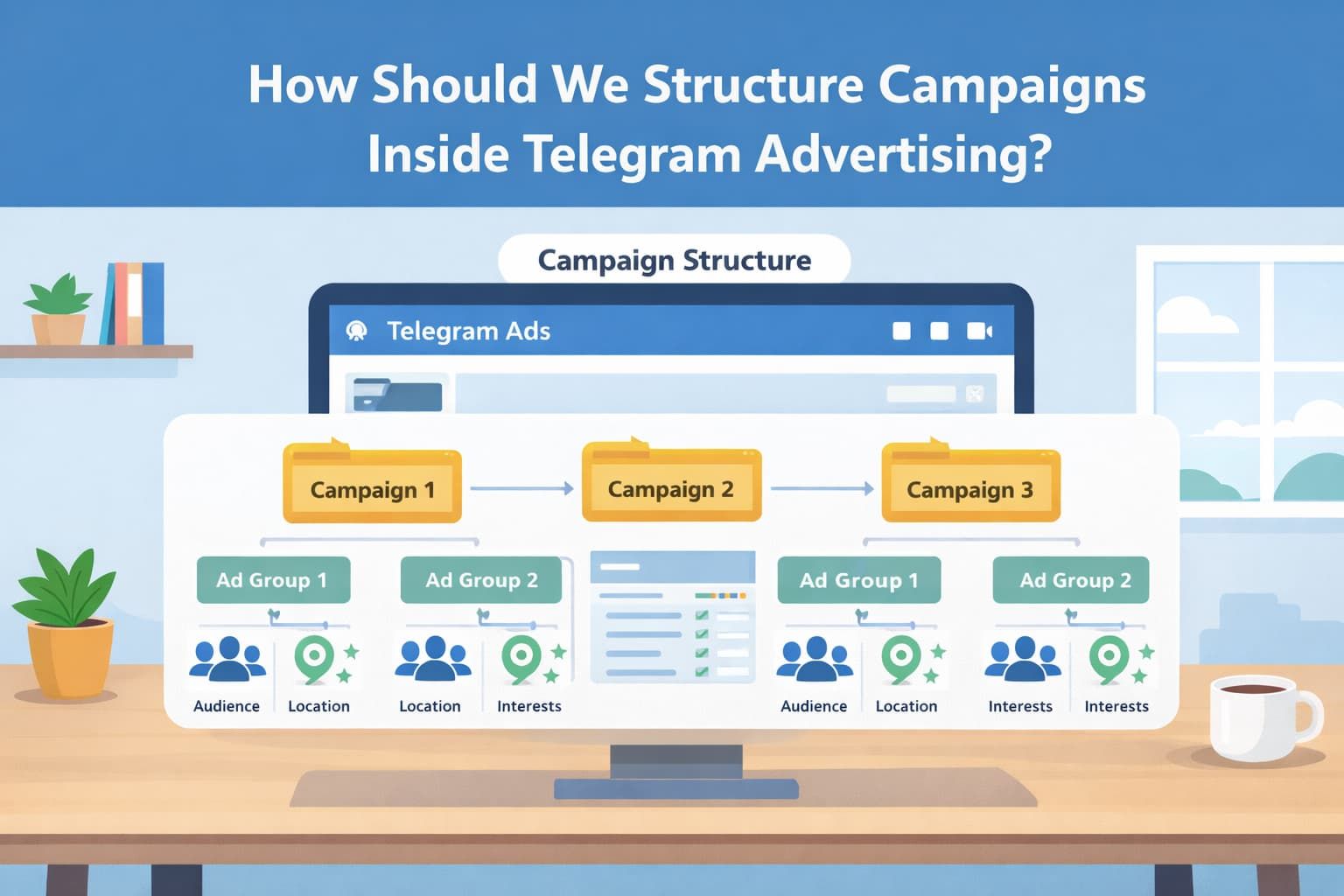
Telegram Advertising uses a simple structure. The Organization holds the balance. Each ad equals one sponsored message of about 160 characters.
Every ad includes:
- A short title and body text
- A CPM bid
- A total budget
- A schedule
- An internal Telegram link in t.me format
External websites cannot be used as the primary link.
We manually set the CPM bid starting at 0.1 TON. The system does not adjust bids automatically. If we want changes, we edit the ad ourselves.
A well-structured campaign includes:
- Organization managing total balance
- One sponsored message per ad
- Text-only creative (around 160 characters)
- Internal destination such as a channel, bot, or sales channel
- Manual CPM bid
- Total budget and optional daily cap
- Frequency limit per user
- Start and end dates
Because targeting cannot be edited after launch, we duplicate ads when structural changes are needed. That keeps active campaigns stable.
How Does Targeting Work and What Are Its Limitations?
Targeting in Telegram Ads is channel-based. We select public channels by entering their links. Ads appear below organic posts as users scroll.
We can filter by language and align with specific topics such as finance, education, or technology. There is no pixel tracking and no external conversion optimization.
Targeting options include:
- Specific channel URLs
- Language filters
- Topic alignment
- Audience profile assumptions
A simple comparison helps clarify the limits:
| Feature | Telegram Ads | Meta Ads |
|---|---|---|
| External links | No | Yes |
| Pixel tracking | No | Yes |
| CPM bidding | Yes, min 0,1 TON | Yes |
| Interest targeting | Limited | Advanced |
Because interest targeting is limited, channel research matters. The quality and relevance of selected channels directly affect performance.
How Do Bidding and Budget Optimization Actually Work?
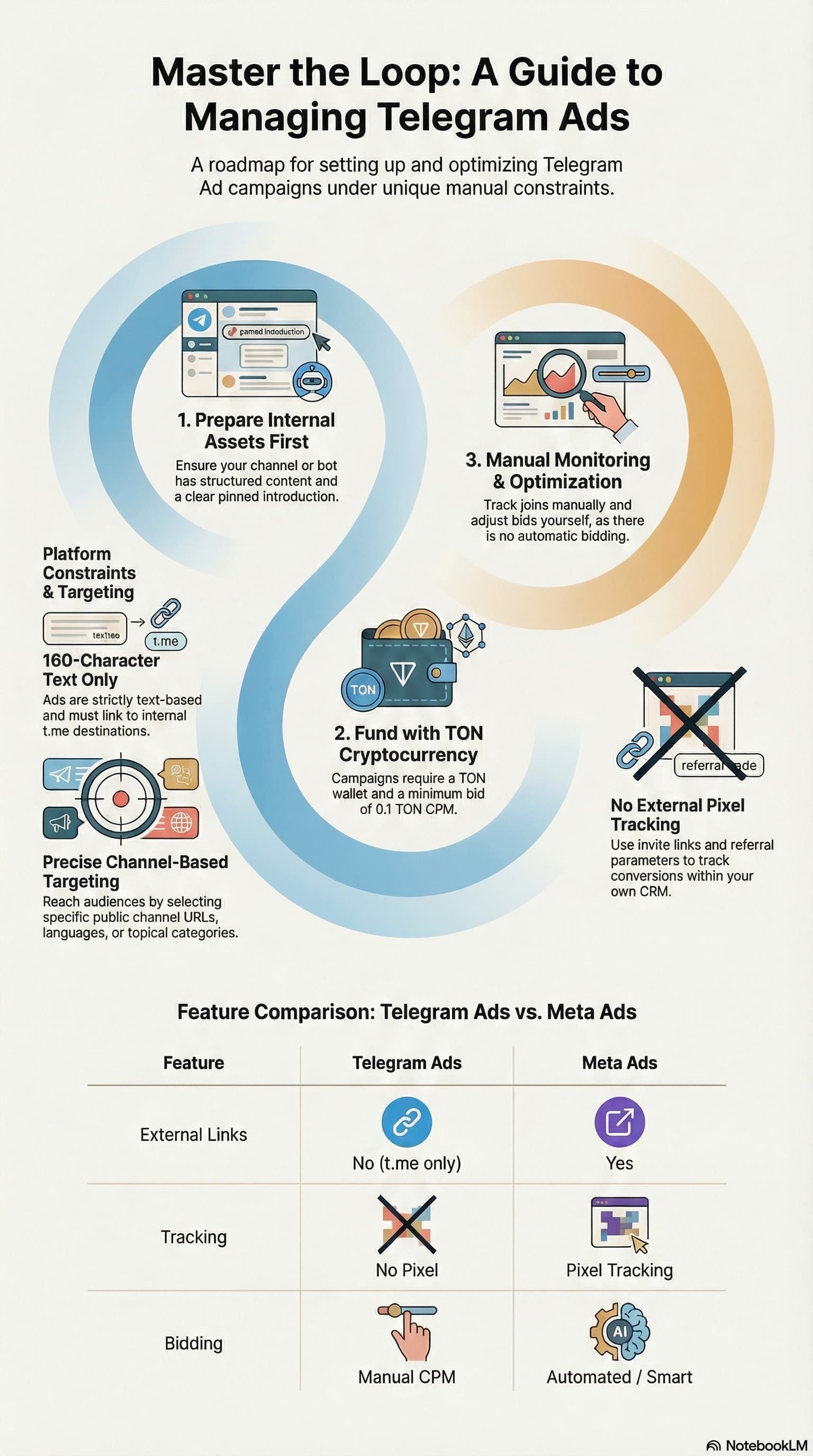
Telegram Ads runs on a fixed CPM auction. We manually adjust bids starting from 0.1 TON to improve delivery.
If competition increases in a chosen channel, impressions may slow down. In that case, we raise the CPM to gain priority. There is no automatic smart bidding.
We define a total budget in TON and can set a daily cap. If performance drops, we pause or delete the ad. Unspent funds return to the Organization balance.
To manage optimization clearly:
- CPM determines auction priority
- Higher bids increase delivery speed
- Budget can be increased during a campaign
- To reduce spend, we pause or delete ads
- Budget can be reallocated during quarterly planning
Basic formula:
Cost per join = Spend ÷ Joins
We calculate this weekly and compare results across thematic channels. That comparison guides decisions.
What Causes Telegram Ads to Get Rejected?
Ads are usually rejected for clear reasons. Sensitive subjects, overblown claims, thin channel content, or sloppy targeting can all cause problems. Telegram also makes clear that,
“Advertisers are responsible for their ads and for complying with… these Ad Policies and Guidelines.” - Telegram Ads guidelines
That responsibility places approval risk directly on campaign setup and message accuracy.
In community reports, ads that sound like ‘easy money’ or guaranteed returns often face extra scrutiny from moderators, especially in financial or crypto niches.
Common rejection triggers:
- Promises tied to crypto or financial returns
- Statements that guarantee income
- Channels with little content or no clear purpose
- Attempts to push users outside Telegram
To lower the chances of rejection:
- Build out the channel before running ads
- Remove language that sounds exaggerated or absolute
- Make sure the targeting matches the actual content
- Double-check that the channel is public and complete
A well-prepared channel and realistic copy make the review process smoother.
How Do We Measure Performance Without External Tracking?
Credits: The School of Digital Marketing
Inside Telegram Ads, we can see impressions and total spend. Conversions are different. Since there is no pixel, we track joins and bot starts on our side, using invite links or referral parameters to see what is working.
Inside the platform, we monitor:
- Impressions
- Spend
For conversions, we track:
- Channel joins
- Bot start events with referral parameters
Telegram shares 50 percent of ad revenue with channel owners, according to core.telegram.org documentation. While this supports publishers, it does not provide advanced advertiser analytics.
To improve accuracy, we can add:
- Referral parameters in bot links
- Manual CRM tagging
- Comparison with other traffic sources
Without automated attribution, disciplined data tracking becomes essential.
When Should We Use Third Party Networks Instead?
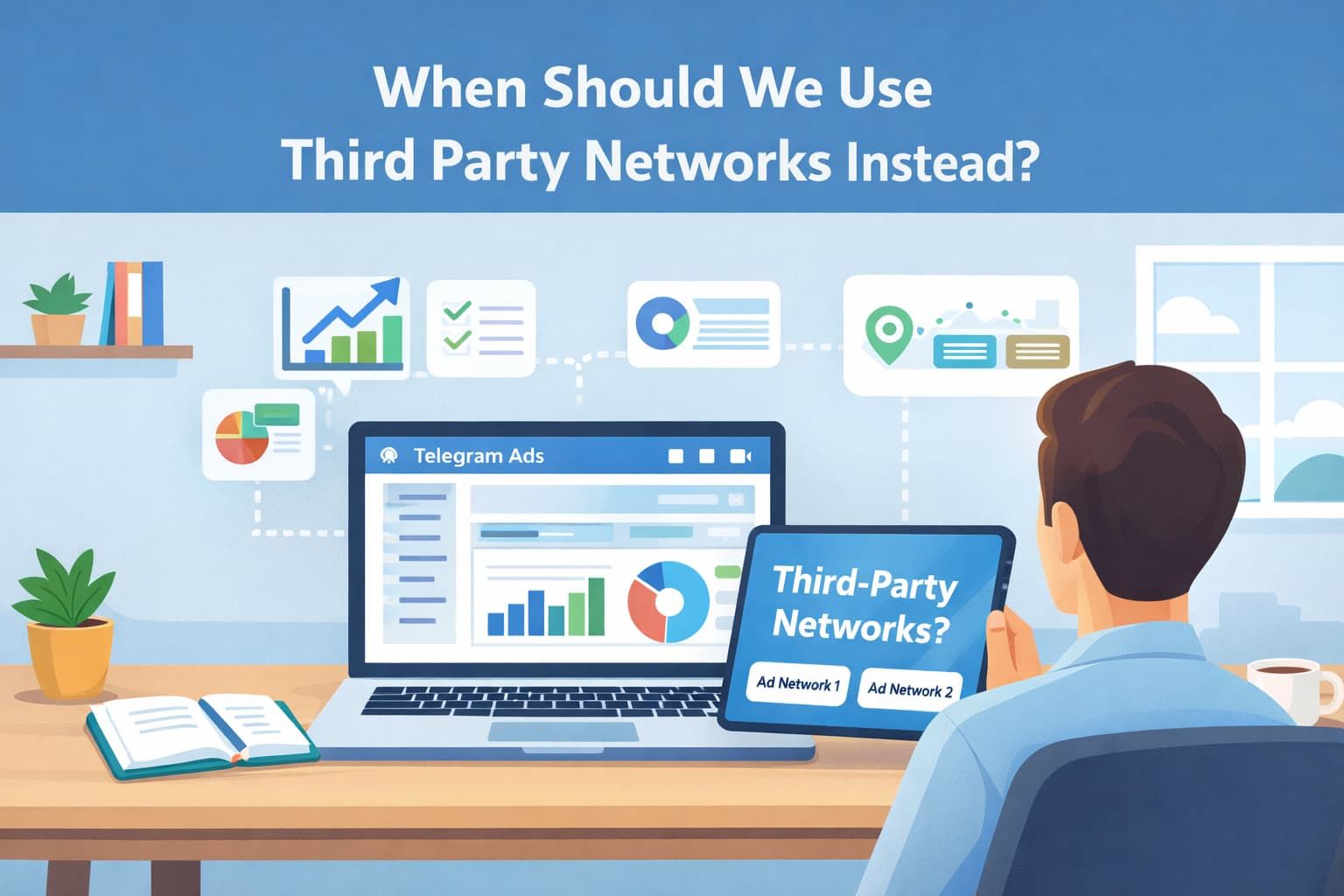
Third party networks may be useful when we need CPC pricing, advanced targeting such as Wallet or Premium users, or mini app placements beyond official Telegram Ads.
Official Telegram Ads runs only on CPM. Some third party networks, such as RichAds, report CPC options starting around 0.015 USD for certain formats. This may suit performance-focused campaigns.
Comparison:
| Model | Official Telegram Ads | Third Party Networks |
|---|---|---|
| Pricing | CPM only | CPM and CPC |
| CPC starting | No | 0.015 USD |
| Mini app inventory | Limited | Exanded |
| Wallet targeting | Limited | Advanced |
We may consider third party networks when:
- CPC is required
- Promoting Telegram Mini Apps
- Targeting Wallet or Premium users
- Entering a more aggressive scaling phase
The choice depends on campaign goals and risk tolerance.
FAQ
How does Telegram Ads reach the right target audience effectively?
Telegram Ads reaches the right target audience by aligning message placement with user interests, behavior patterns, and thematic channels. Clear targeting settings guide messenger marketing toward people most likely to complete a target action.
A defined performance strategy, supported by quarterly planning and a structured content plan, improves visibility, builds audience loyalty, and strengthens emotional connection across sales channels consistently.
What role does a chat bot play in Telegram Advertising results?
A chat bot supports Telegram Advertising by providing immediate responses, guiding users through the Customer Journey Map, and encouraging each target action. It connects visitors from external sources to relevant sales channels without confusion or delay.
Consistent automated communication reinforces branding tasks, improves audience loyalty, and enables accurate measurement of performance strategy results during structured quarterly planning across thematic channels.
When should quarterly planning adjust a Telegram Ads performance strategy?
Quarterly planning should adjust a Telegram Ads performance strategy when data reveals declining engagement, weak audience response, or low target action completion.
Reviewing the content plan, branding tasks, and messenger marketing indicators helps refine targeting across thematic channels, sales channels, and video messages. Evidence based changes strengthen emotional connection, restore audience loyalty, and align activity with the Customer Journey Map.
How can thematic channels improve audience loyalty and emotional connection?
Thematic channels organize content around shared interests, making messenger marketing feel relevant and purposeful. Consistent storytelling, practical video messages, and clear branding tasks guide users through the Customer Journey Map toward a meaningful target action.
This structured experience deepens trust, encourages repeat engagement, and builds long term audience loyalty while supporting measurable performance strategy growth across social networks and sources.
Do external sources or sales channels matter for Telegram Ads success?
External sources expand reach, and well designed sales channels convert attention into measurable outcomes. Effective Telegram Advertising connects social networks, chat bot guidance, and a structured content plan to move users toward a clear target action.
Careful quarterly planning aligns branding tasks, audience loyalty, and performance strategy so each interaction strengthens emotional connection and supports stable, predictable growth over time.
What Is the Full Operational Loop for Long Term Telegram Ads Management?
Long-term Telegram Ads management follows a repeatable cycle built on planning and steady optimization.
We begin by defining the KPI and target action. Then we improve the channel and onboarding flow. After that, we launch multiple ad variants across different thematic channels.
Every week, we measure cost per join and activation. Agencies explain how Telegram ad agencies operate to adjust bidding, optimize channel targeting, and expand high-performing campaigns while maintaining steady audience growth.
The long-term loop looks like this:
- Define KPI and target action
- Optimize channel and onboarding flow
- Launch multiple creative variants
- Monitor cost per join
- Pause low performers
- Expand high-performing channels
- Reallocate budget quarterly
- Strengthen audience loyalty
Growth with Telegram Ads comes from consistency, not short bursts. It works best when treated as part of a broader messenger marketing strategy.
If you need structured support with this process, you can review specialized services at Telegram Ads Agency and decide whether professional management fits your goals.
References
- https://ads.telegram.org/getting-started
- https://ads.telegram.org/guidelines
Related Articles