A Practical Guide to Managing Telegram Ad Performance
Managing Telegram ad performance is the process of using campaign data to make informed decisions. It helps identify which campaigns generate profitable results and which do not.
The platform shows views and cost, but real management tracks what happens after the click, subscribers, leads, sales. It’s constant adjustment: testing channels, judging creatives, moving budget. Without tracking the full journey, you’re just guessing.
Keep reading for the essential principles of active campaign management.
Quick Performance Management Essentials
Use these principles as a guide for managing campaign performance.
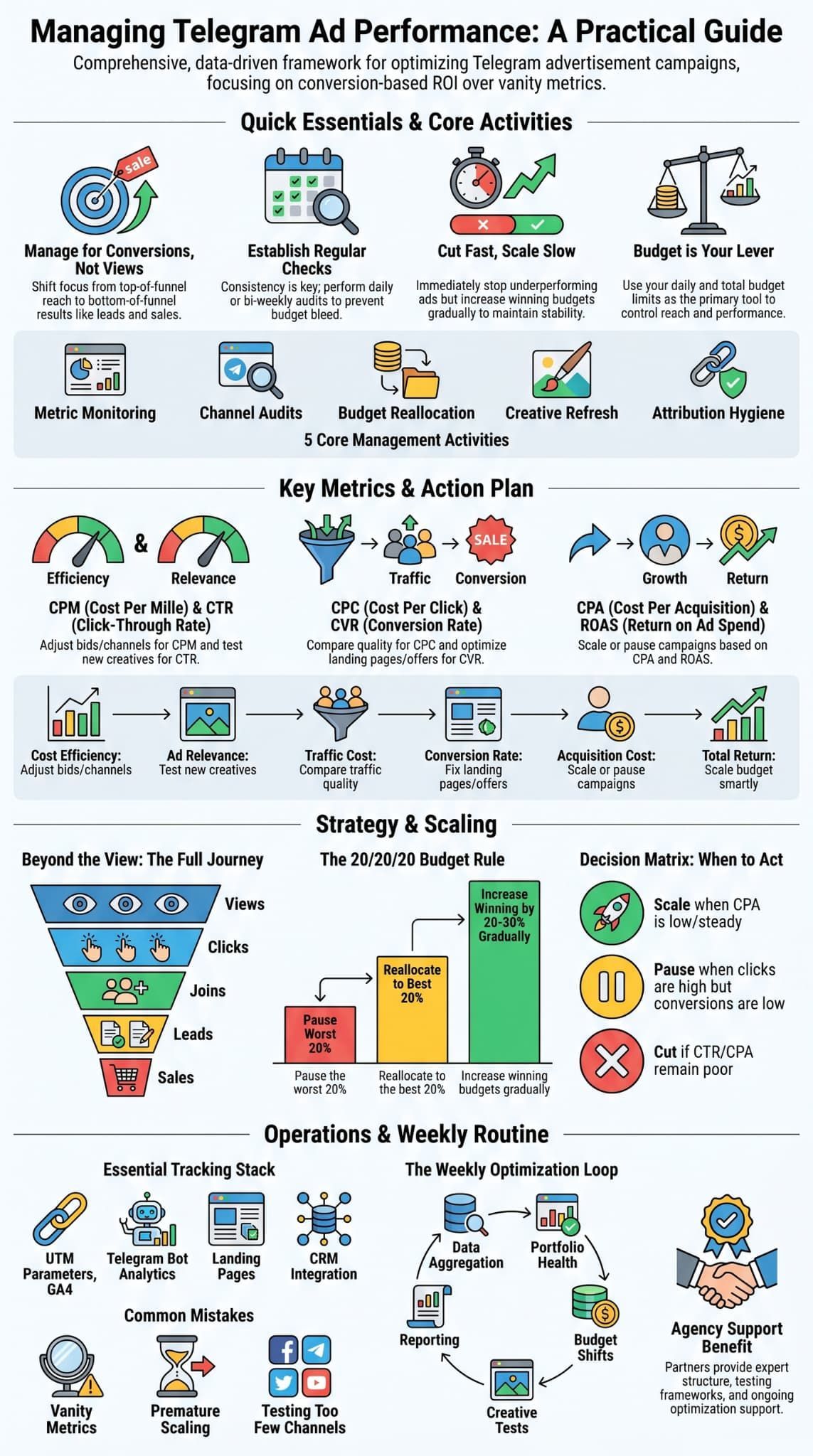
- Manage for Conversions, Not Views: A million views mean nothing if they don’t lead to a tracked action. Your main number must be a business result.
- Establish a Rhythm: Performance gets worse quietly. Plan regular checks, daily for new campaigns, weekly for stable ones, to catch problems early.
- Cut Fast, Scale Slow: Find underperforming ads or channels quickly and move that money. Grow winning campaigns in small steps, watching for any drop in results.
- Your Budget is Your Lever: Don’t just set it and forget it. Actively move money from what’s not working to what is. This is your most powerful tool for improvement.
What Does Managing Telegram Ad Performance Actually Mean?

In practice, it is a continuous process. You launch campaigns based on ideas. You collect data. You analyse that data against your key goals. You then make informed changes to the campaign's parts: audience, creative, bid, budget.
Then you repeat. It's not a one-time "set and forget" task; it requires regular adjustments to improve campaign performance over time. For sponsored messages, this means looking past the view count and asking, "What did this view cost, and what real value did it create?"
Data from IOP Conference Series: Materials Science and Engineering demonstrates
"The authors attempted to develop a methodological approach towards analyzing and planning of advertising campaigns in social media based on the analysis of the factors characterizing quantitative parameters of the Internet platform development and its target audience distribution... The analysis concluded that Telegram platform is suitable for analyzing and planning of promotion campaigns in any business field." - IOP Conference Series: Materials Science and Engineering
The Five Core Activities of Performance Management
Break your week down into these tasks.
- Proactive metric monitoring protects campaigns from sudden performance drops. Teams must constantly monitor native spend charts alongside external CRM data to catch sudden cost spikes before they burn through daily caps.
- Continuous placement audits filter out low-quality channel networks. Media buyers should run regular verification checks on target channels to confirm that subscriber engagement metrics are driven by authentic community activity rather than bot scripts.
- Proactive budget reallocation shifts capital away from low-yielding channel placements. Media buyers must actively drain funds from poorly converting targets and instantly route that liquid capital into high-converting campaigns to maintain scale.
- Aggressive creative refresh cycles insulate your ad accounts from creative fatigue. Creative assets should be systematically rotated the moment your click-through rates begin to dip, allowing you to deploy fresh visual variations before your customer acquisition cost spikes.
- Attribution Hygiene: Making sure your UTM tags, Telegram Pixel, and bot tracking are correctly following the customer's journey from view to conversion.
Which Telegram Ad Metrics Matter Most?
You can drown in data. The key is to focus on the numbers that directly tell you what to do next. Telegram’s interface gives a base: CPM, Budget, Views, and the graph of Views vs. Joins. This is your first layer.
The second, more important layer is outside Telegram. It connects that first view to real business results.
| Metric | What It Tells You | The Action It Informs |
|---|---|---|
| Cost Per Mille (CPM) | Your cost per 1,000 views. The basic efficiency of your media buy. | Is your bid too high for this audience? Should you test a lower CPM or a different channel? |
| Click-Through Rate (CTR) | The percentage of viewers who clicked. A direct measure of ad relevance and hook strength. | Is the creative good? Does it match what the channel audience wants? Time for an A/B test. |
| Cost Per Click (CPC) | Your cost per click. Shows the true cost of traffic. | How does this traffic cost compare to other channels? Is the quality of the click worth this price? |
| Conversion Rate (CVR) | The percentage of clicks that became a conversion (like a lead or sale). Measures your post-click experience. | Is the offer or landing page what the ad promised? Is there a problem in the conversion path? |
| Cost Per Acquisition (CPA) | The cost of getting a subscriber, lead, or sale. The ultimate efficiency metric. | Is this campaign profitable? Should you grow it, pause it, or change it completely? This is your go/no-go signal. |
| Return on Ad Spend (ROAS) | The actual financial return. For e-commerce or direct sales. | What’s the real profit? This decides your maximum budget for scaling. |
Why Are Telegram Views Alone Not Enough?
Credits: Zero to Influence
High view counts can be a seductive trap. They make a report look good, but they can hide real failure. A campaign can have a great CPM and millions of views, yet get zero good leads because the audience, while large, is completely wrong.
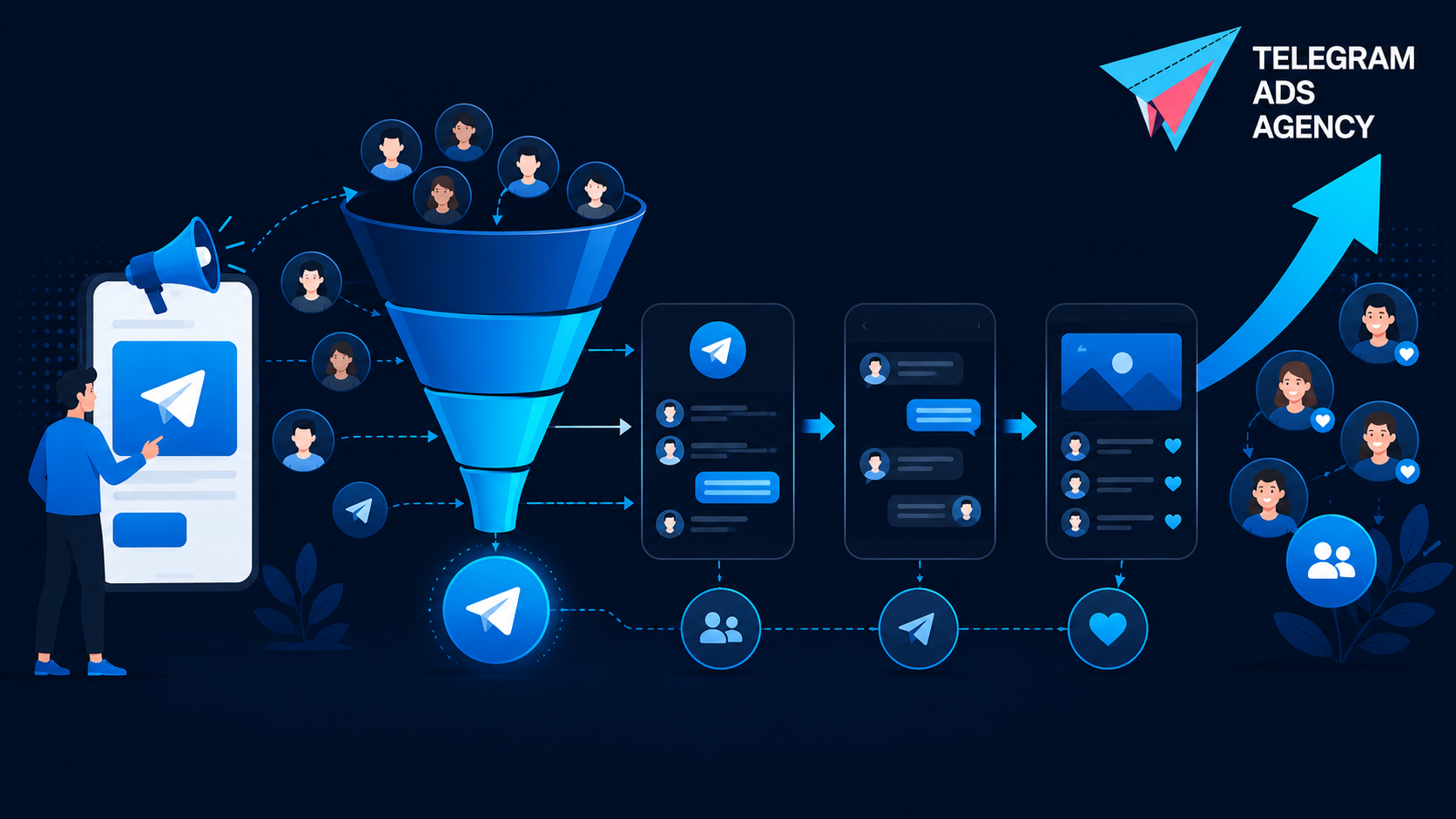
The view is just the first step in a funnel. Performance management is about managing the entire funnel.
You must track what happens after the view. Did the user click? Did they join the channel? Did they start the bot? Did they fill out a form? If you're not measuring these next steps, you're not managing performance; you're just watching an expense.
As noted by SMIT.LINK on Medium
"A major problem with Telegram is the lack of in-depth channel analytics. Entrepreneurs, marketers, and admins are often forced to treat their channel as a 'black box.' You invest money into acquiring subscribers, and at some point, some of them buy your products. But who exactly are these buyers, and which ad brought them in? You can't find out, so you end up relying on gut feeling." -
SMIT.LINK
How Can You Adjust Budget and CPM Without Losing Control?

Budget management is active, not passive. Telegram's interface lets you increase an ad's budget and adjust its CPM bid. These settings allow you to manage campaign performance. Effective managing Telegram ads campaign performance depends on making these adjustments based on verified conversion data rather than impressions alone.
Systematic capital optimization requires a strict budget redistribution model. Rather than injecting raw capital into flatting campaigns, media buyers should run weekly performance tranches.
By automatically isolating the lowest-performing quintile of your active channel placements based on acquisition costs, you can safely pause underperforming ad groups and redirect that capital into your highest-converting funnels.
Take that money and give it to the top 20% of performers. Increase their budgets in 20-30% steps, watching closely for any drop in efficiency. This allows more budget to be allocated to higher-performing placements.
Why Is Tracking Beyond Telegram Essential?
Telegram's native reporting is a snapshot, not the full story. It tells you the beginning (the view, sometimes the click), but rarely the ending (the sale, the long-term value).
Relying only on Telegram reporting provides an incomplete view of performance. You need external systems to see clearly. This is non-negotiable for performance management.
Without it, you cannot accurately calculate your cost per result or return, or know which part of your audience is most valuable. You're optimising in the dark.
This is why Telegram campaign setup and optimization should include external attribution systems before significant budget decisions are made.
The Minimum Viable Tracking Stack
- UTM Parameters on Every Link: This is free and basic. It sends clean, source-specific data into Google Analytics 4.
- Google Analytics 4 Event Tracking: Set up conversions for key actions: page views, form submissions, purchases. Use the UTM data to sort by Telegram campaign and channel.
- Telegram Bot Analytics: If you're getting bot starts, use the Bot API to log user actions. Consider a simple connection to a spreadsheet to track users from the /start command to a paid conversion.
- Dedicated Landing Pages or Offer URLs: For important campaigns, use a unique landing page. This separates Telegram traffic completely, removing all confusion about where it came from.
- CRM Integration: For B2B or high-value leads, send UTM data into your CRM. This links ad spend directly to potential sales and revenue.
When Should You Cut, Pause, or Scale a Campaign?
These are the three key decisions. Making them based on a feeling is a luxury you can't afford. Let pre-set data rules guide you. Set these benchmarks before you launch.
| Scenario | Data Signal | Recommended Action |
|---|---|---|
| Scale | Cost per result is consistently below target, return is high and stable. Channel shows no sign of fatigue after small budget increases. | Increase budget in 20-30% steps every 3-4 days. Consider expanding to similar channels or testing new ad ideas for the same winning audience. |
| Pause & Investigate | Clicks are high, but conversions are low or zero. Cost per click is okay, but cost per result is very high. | Pause spending. Find the problem. Is the landing page broken? Is the offer misleading? Is the audience broad but not right? Fix the funnel, then restart with a small test budget. |
| Cut (Kill) | After enough testing (1k+ views), the cost per result is 2-3x your target, click-through rate is very low (<0.2%), or the channel quality is clearly poor (bot comments, no engagement). | Stop the ad. Do not put more money in. Move the budget to your next best test. Write down why it failed (e.g., "Channel X: audience was Russian, but offer was English-only"). |
| Refresh | A previously winning campaign shows a steady drop in clicks and rise in cost over 7-10 days, meaning the ad is tired. | Pause the old ad. Launch 2-3 new versions (new hook, new image) to the same proven audience. See which one brings performance back. |
What Common Mistakes Hurt Telegram Ad Performance?
Most performance problems are self-inflicted. They come from skipping steps in the disciplined process. Recognising these pitfalls is the first step to avoiding them.
The Five Costly Errors
- The Vanity Vortex: Optimising for low CPM or high views because it makes the dashboard look good, while ignoring the dropping conversion rate. You become a master of cheap, useless traffic.
- Premature Scaling: Finding one channel that works and immediately putting 80% of your monthly budget into it. This often leads to quickly using up the audience and a much higher cost per result within days.
- Portfolio Poverty: Testing only 3-5 channels because "they look big." This doesn't give enough data to be sure, and you'll likely miss the real high-performers.
What Does a Weekly Telegram Ad Optimisation Routine Look Like?
Consistency beats heroic, sporadic effort. Block 60-90 minutes each week for this structured review. Use a checklist. The same discipline is commonly seen in managed Telegram ad campaigns, where recurring performance reviews drive ongoing efficiency gains.
1. Data Aggregation (15 mins):
- Export key numbers from Telegram Ads Manager for the past 7 days.
- Pull conversion data from GA4, your CRM, or bot analytics.
- Combine into a master spreadsheet comparing Channel, Spend, Views, Clicks, Conversions, and Cost Per Result.
2. Portfolio Health Diagnosis (20 mins):
- Flag any campaigns where the cost per result went over your target by more than 20%.
- Find any channels with a big week-on-week drop in click-through rate (showing the ad is getting tired).
- Note any new placements that have reached their 1,000-view test limit and are ready for a decision.
3. Budget Reallocation Decisions (15 mins):
- Based on the data, decide which 1-2 placements to pause or stop.
- Decide which 1-2 winning placements deserve a budget increase (and by how much).
- Approve budget for 1-2 new tests (new channel or creative) using the freed-up money.
4. Creative & Test Planning (10 mins):
- Schedule making 1-2 new ad versions to fight fatigue in key campaigns.
- Finalise the targeting for next week’s new channel tests.
5. Reporting & Documentation (10 mins):
- Update any client or internal reports with key insights.
- Write down the decisions made and your ideas for the coming week in a shared log.
FAQ
How can I accurately measure Telegram ad performance?
Measure campaign performance using campaign-level metrics such as Monthly impressions, click-through rates, conversions, and engagement. A real-time dashboard improves performance visibility by showing results as they happen.
Reviewing these metrics regularly helps identify underperforming campaigns, improve campaign management decisions, and allocate ad spend more effectively.
How do you isolate the correct target audience inside the ad dashboard?
Media buying success depends on using clean targeting parameters rather than broad targeting loops. You must segment your ad groups by explicit channel language, verified geographic regions, and specific community themes to prevent your budget from bleeding into unverified feeds.
Filtering out broad public channels ensures your impressions are served exclusively to high-intent users.
When should I adjust my Telegram ad budget?
Adjust your ad budget based on measurable results rather than assumptions. If an advertising campaign consistently achieves strong performance at an acceptable CPM pricing level, increasing investment may generate additional growth.
If results decline, review targeting parameters, creative content, and ad placement before making budget changes.
What tools help manage Telegram advertising performance?
Performance tracking becomes easier when data is organized in a structured reporting system. Many advertisers use Google Sheets to analyze results and connect campaign data through an API Token or OAuth Token.
These tools support performance optimization by making campaign reporting, trend analysis, and decision-making more efficient.
How can I improve campaign results without increasing ad spend?
Improve performance by refining sponsored messages, updating creative content, and testing different targeting parameters. Compare results across Telegram Groups and Telegram Channels to identify which placements generate the strongest engagement.
Small improvements in relevance, messaging, and audience targeting often increase campaign performance without requiring additional media ads spending.
Turning Telegram Ad Data Into Long-Term Growth
You need external tracking systems to measure results accurately. The businesses that grow successfully on Telegram are the ones that review performance regularly, test new ideas, and make decisions based on data rather than assumptions. Over time, this improves acquisition efficiency and provides better insight into audience behaviour.
If managing campaigns feels time-consuming, working with a specialised
Telegram Ads Agency can help. The right partner can bring structure, testing frameworks, and ongoing optimisation, helping you build a measurable and scalable Telegram advertising programme.
References
- https://beta.iopscience.iop.org/article/10.1088/1757-899X/986/1/012014/meta
- https://medium.com/@gurumarketing121/advertising-on-telegram-how-to-analyze-the-results-e9f9fd459dc3
Related Articles