Optimizing Telegram Ad Campaigns: What Matters Most
Telegram ad optimization needs ongoing testing and adjustment. For brands and marketers, it's what turns wasted spend into a scalable, high-ROI channel. The platform allows advertisers to reach highly specific audiences.
Running an unoptimized campaign under Telegram’s impression-based pricing model will quietly bleed your ad budget dry. Because the platform charges for views (CPM), not actions, showing generic ads to a broad audience wastes money instantly. To protect your budget, you need a data-driven workflow that matches specific audience data with constant creative testing.
Keep reading to learn the core principles of a profitable campaign.
Quick Optimisation Insights
Before you adjust a single bid, internalise these core principles. They form the foundation of every successful campaign.
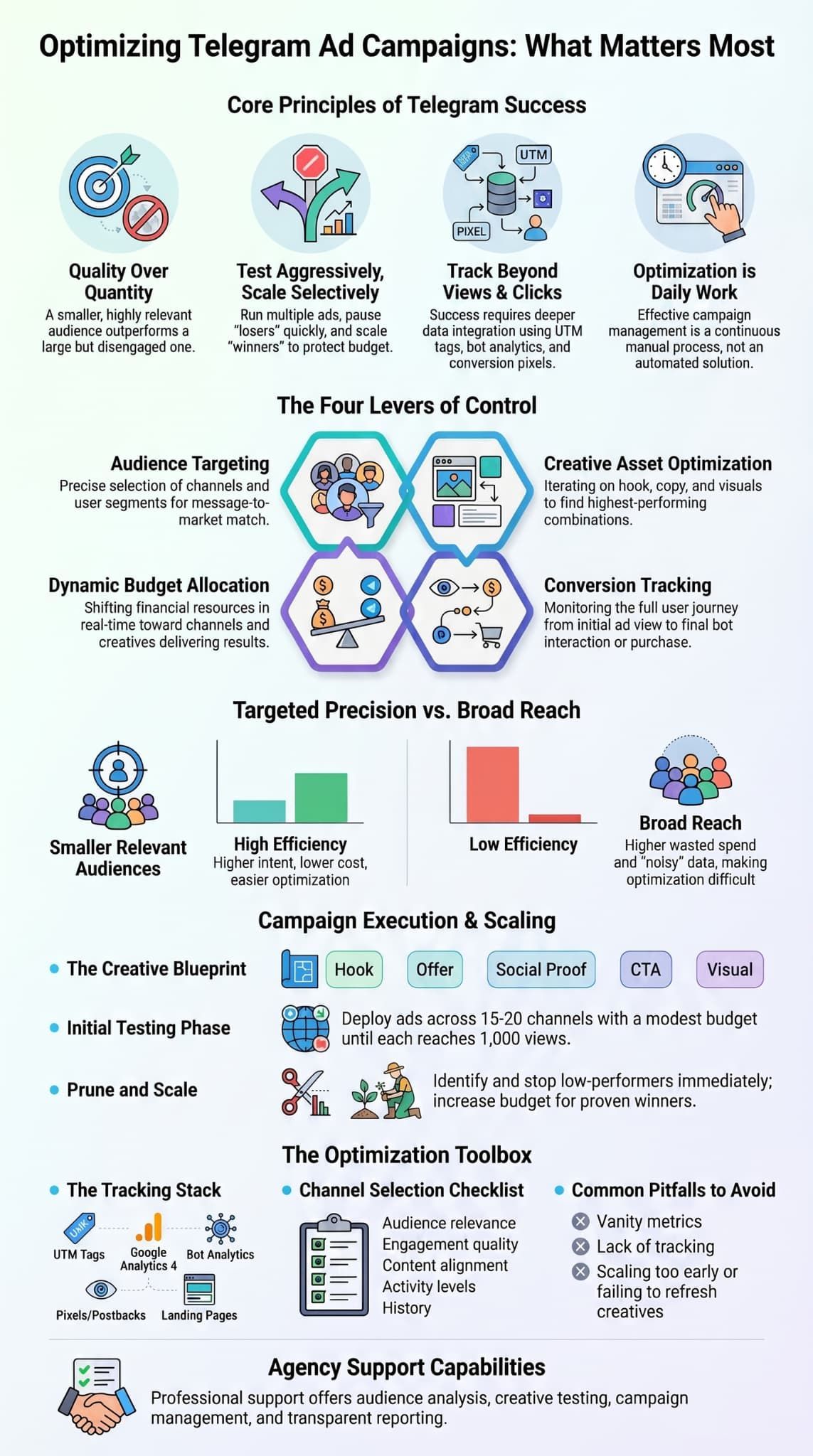
- Quality Over Quantity: A smaller, hyper-relevant channel audience will always beat a massive, disengaged one. Reach is a vanity metric; relevance is your ROI.
- Test Aggressively, Scale Selectively: Launch multiple ad variants across different channels. Stop underperformers quickly and invest only in what clearly works.
- Track Beyond the Platform: Telegram's stats show views and clicks. Your business needs leads, joins, or sales. Bridge that gap with UTM parameters, bot analytics, or pixel tracking.
- Optimise is a Verb, Not a Setting: There's no "optimise" button. It's the daily work of analysing data, making improvements, testing, and iterating based on real results.
What Does Telegram Ad Optimisation Actually Mean?
At its core, optimisation is the process of improving the economic efficiency of your ad spend. You're systematically lowering the cost of getting your goal, whether that's a new channel subscriber, a bot start, or a product sale.
On Telegram, you control this through several key levers. It means moving from showing a generic message to large channels to carefully matching a specific offer with a specific community's known interests. It's a shift from guessing to knowing, driven by data from each campaign you run.
The Four Levers You Control
These are the primary campaign variables you can adjust. You adjust them based on performance data.
- Audience Targeting: Which channels, and therefore which groups of Telegram users, see your ad.
- Creative Asset Optimization: The strategic alignment of your hook, body copy, and visual asset to maximize your Click-Through Rate (CTR) within a highly competitive, fast-scrolling native feed.
- Dynamic Capital Allocation: The tactical distribution of your ad budget across variable channel sets, ensuring you aggressively scale winning placements while instantly pausing low-yield channels.
- Conversion Tracking: The methods you use to connect a sale, lead, or new member back to a specific ad and channel.
How Do You Choose the Right Channels for Telegram Ads?
Credits: Story Number 1
Channel selection is the single most important optimisation choice. The official platform requires channels with 1,000+ subscribers, but that's just the entry ticket.
The real work is checking the channel. You're placing ads in an existing community audience. Does their conversation match your offer? This evaluation process is one of the most important parts of managing Telegram ads campaign performance over time.
An e-commerce bot for sneakers will fail in a channel about Byzantine poetry. Tools like TGStat or TeleTarget can provide data, but the best check is to actually read the channel's recent posts and see how engaged people are.
A Practical Channel Evaluation Checklist
Use this before adding any channel to your target list.
- Audience Relevance: Does the channel's main topic directly connect with your product or service? Look at the content, not just the title.
- Engagement Quality: Scroll through the last 20 posts. Are there comments, reactions, shares? A large but silent audience is a poor place for ads.
- Content Alignment: Is the posting style and tone a good fit for your brand? A formal financial analysis channel may not work for a meme-heavy crypto game ad.
- Posting Activity: Is the channel active daily? A dormant channel, even with millions of subscribers, means disengaged users.
- Historical Ad Presence: Have other advertisers run similar offers there recently? If yes, it's a sign the audience is used to that type of product.
Why Do Smaller Relevant Audiences Often Outperform Broad Reach?
One common finding in Telegram advertising is that smaller targeted audiences often outperform larger general audiences.
A campaign in five perfectly aligned channels of 5,000 subscribers each can easily beat a campaign in one broad channel of 500,000. The reason is signal-to-noise ratio. In a broad channel, many users may have little interest in your offer. In a niche channel, it can be seen as a relevant suggestion.
The targeting is tighter, which means fewer wasted impressions on users who have no interest. This focus directly lowers your cost-per-action and increases the long-term value of the user you acquire.
| Targeting Smaller, Relevant Audiences | Chasing Broad Reach Campaigns |
|---|---|
| Higher Intent: Users are in the channel specifically for its topic. | Lower Intent: Users are there for general content, not your niche. |
| Lower CPE: Cost-per-engagement (or conversion) is typically lower due to relevance. | Higher Wasted Spend: Paying for thousands of irrelevant impressions. |
| Easier Optimisation: Fewer variables, clearer feedback on what works. | Noisy Data: Hard to isolate why a campaign succeeded or failed. |
| Community Trust: Ads can leverage the channel owner's established authority. | Interruption Marketing: The ad may be less relevant to the audience. |
How Can You Write a Telegram Ad Creative That Gets Clicked?
Telegram's ad format is a sponsored message, built into the chat. It has seconds to convince someone. The creative must communicate its message quickly. Long, complicated text fails. The best ads sound like a successful post from the target channel itself.
They start with a hook that speaks directly to a known problem or want of that community. The offer is single and clear.
The call to action is simple: "Join Channel," "Start Bot," "Shop Now." For video ads, the first three seconds are everything. They must show relevance before the user scrolls away.
As noted by IOP Conference Series: Materials Science and Engineering
"The analysis concluded that Telegram platform is suitable for analyzing and planning of promotion campaigns in any business field." - IOP Conference Series: Materials Science and Engineering
A Blueprint for High-Performing Ad Creative
- The Hook (First Line): Talk to the audience directly with a benefit or question. "Tired of missing crypto signals?" or "Want to grow your Telegram channel faster?"
- The Offer (Body): State one clear, strong offer. "Get our free on-chain analysis bot." Avoid listing many features or benefits.
- The Social Proof (Optional but Powerful): "Joined by 15k+ traders" or "Featured in [Relevant Channel Name]."
- The CTA (Final Line): Use a direct command verb. "Tap to start the bot" or "Click to join the private group."
- The Visual: Use a clear, high-contrast image or short video loop. For crypto, a clean chart or app screenshot. For e-commerce, a product photo on a plain background.
What Is the Best Approach to Budgeting, Testing, and Scaling?
Optimisation needs a structured testing plan. Don't put your whole budget into one ad in one channel. Use a test budget to learn. Successful managed Telegram ad campaigns typically rely on disciplined testing before significant budget increases are introduced.
A good rule is to start with 15-20 channels. Set a modest daily budget for the whole campaign, letting each ad get at least 1,000 views before you decide.
This stops you from cancelling a potential winner based on random noise. Use A/B testing basics: change one thing at a time (like the headline or image) while keeping everything else the same.
The Five-Step Testing & Scaling Framework
- Launch Multiple Variations: Make 3-5 different ads. Show them across your 15-20 pre-checked channels. This is your learning phase.
- Gather Sufficient Data: Let the campaign run until each ad in each channel has enough views (1,000 is a good start) to be meaningful.
- Analyse & Prune: Find the winning combinations. Look at your tracked goal (cost per lead, cost per join), not just cost-per-click. Stop all underperformers right away.
- Isolate Winners: Take the top 2-3 ads and the top 3-5 channels. Make a new, focused campaign with these proven parts.
- Scale Incrementally: Increase the daily budget on this winning campaign by 20-30% every few days, watching closely for a drop in performance. If it stays good, keep scaling.
How Should You Track Telegram Ad Performance?
Relying only on Telegram Ads Manager is a recipe for poor optimisation. You see clicks, but you don't see what happens next. The platform's real power comes with external tracking.
Every click from your ad must carry a unique tag (UTM parameters) that tells your analytics exactly which ad and channel it came from. Without this visibility, executing Telegram ad campaigns becomes largely dependent on assumptions rather than measurable outcomes. For lead generation, this means connecting to a CRM.
For channel joins or bot starts, you need to set up your bot or use a service that tracks where the user came from. Without conversion tracking, campaign decisions may be based on incomplete data.
Essential Tracking Stack for Telegram Ads
- UTM Parameters: Add tags like utm_source=telegram, utm_medium=paid, utm_campaign=[CampaignName], utm_content=[AdCreativeName] to all your offer links.
- Google Analytics 4 / Funnel Tracking: Use the UTM data to see what users do after they click. Set up conversions for key events (like form submits or purchases).
- Telegram Bot Analytics: For campaigns driving bot starts, use the Bot API to log the /start command and, if possible, link it back to the ad click.
- Postback/Pixel Tracking: For affiliate offers or e-commerce, use a tracker like CPV Lab or a server-side postback to connect sales directly to the ad click.
- Dedicated Landing Pages: Use a unique landing page for each major ad version or channel group to see performance clearly.
Why Do Some Telegram Ads Generate Clicks but Not Conversions?
This is the classic sign of a broken funnel. The ad is good at getting interest (the click), but the next step fails to deliver. The reasons are many. Maybe the channel audience was somewhat relevant but not ready to buy, like crypto fans clicking on a new exchange ad, but not signing up due to KYC worries.
Maybe the landing page loads slowly on mobile, or the offer in the ad isn't clear on the next page. Often, it's a mismatch of intent; the ad promised "free signals," but the landing page immediately asks for a credit card.
Diagnosing the Click-to-Conversion Drop-Off
- Audience alignment issues generate high volumes of low-intent curiosity clicks: When your ad creative targets a channel whose core community interest diverges from your product, users click out of fleeting curiosity but abandon the funnel before taking action.
- Landing page friction violently kills downstream conversion rates: If your destination page introduces a complicated signup flow, suffers from slow mobile loading speeds, or fails to match the exact promise made in your ad copy, users will drop off immediately.
- Misleading Creative: The ad over-promised or was unclear, leading to disappointed clicks and quick exits.
- Technical Issues: Broken links, geo-blocks, or wallet problems (for TON or crypto offers) can stop a conversion completely.
- Lack of Social Proof/Trust: The destination page has no testimonials, verifiable user counts, or secure payment badges, which kills user confidence.
What Common Telegram Ad Optimisation Mistakes Should You Avoid?
Many campaigns fail before they even begin due to avoidable errors. The most common is "spray and pray", using a large budget on a poorly defined campaign and hoping for the best.
Another is analysis paralysis, testing too few ad versions for too long and never getting enough data to decide.
A critical mistake is optimising for the wrong number, like chasing the lowest cost-per-click while your cost to get a real customer gets very high. Each of these comes from not having a disciplined, step-by-step plan.
In a recent analysis by HSE University (National Research University Higher School of Economics)
"Content built on the logic of integration (myth-busting and behind‑the‑scenes formats) is perceived as statistically significantly more credible and less intrusive compared to content built on the logic of overcoming (discounts, reviews)." - HSE University (National Research University Higher School of Economics)
The Costly Errors to Eliminate
- Chasing Vanity Metrics: Optimising for impressions or clicks instead of a real business goal (like cost per lead or sale).
- Ignoring Tracking Setup: Starting campaigns without UTM tags or conversion tracking, making true optimisation impossible.
- Scaling Too Early: Increasing budget on a "feeling" before you have enough data, often wasting money.
- Testing Too Few Channels: Using only 2-3 channels limits your learning and misses potential high-performance spots.
- Neglecting Creative Refresh: Ad fatigue is real. Even good ads lose effectiveness over time and must be regularly updated and tested again.
How Can Telegram Ads Agency Support Campaign Optimisation?
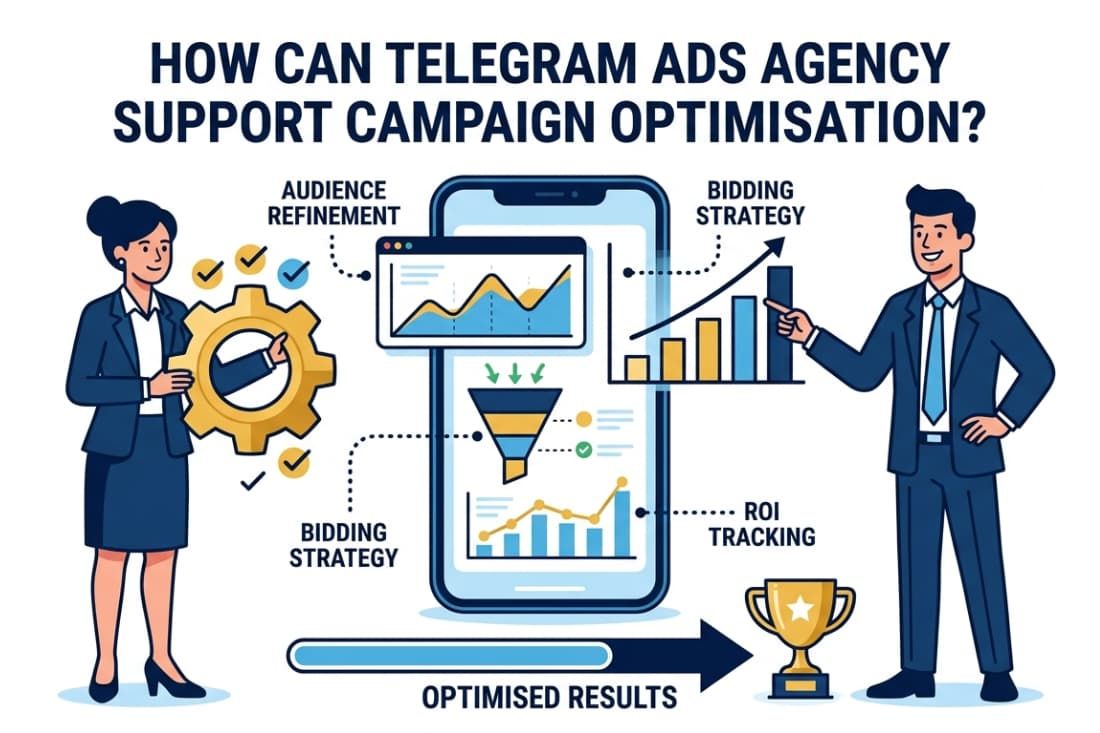
For many businesses, managing this entire optimisation process in-house is a big operational task. This is where a specialised partner like Telegramads.agency can help.
Their role is to manage campaign planning, testing, and optimisation. They work as an extension of your team, using a structured method for checking channels, testing creatives, and tracking performance.
Their service focuses on making Telegram advertising into a measurable growth channel. They do this by aligning the campaign plan, audience choice, and optimization work with your specific business goal, whether that's getting more subscribers, leads, or direct sales.
The Agency Optimisation Workflow
Based on their stated services, a proficient agency would typically:
- Deep-Dive Audience Analysis: Use their own tools and market knowledge to build a targeted channel list that goes far beyond a basic platform search.
- Structured Creative Lab: Create and A/B test multiple ad versions, using performance data from across their clients to guide best practices.
- Full Campaign Monitoring & Management: Actively manage bids, stop underperformers, and grow winners, handling the daily optimisation work.
- Transparent Reporting & Attribution: Provide reports that link ad spend directly to business results using advanced tracking setups.
- Ongoing Strategic Optimisation: Constantly look for new channel opportunities, test new ad formats (like video), and improve the strategy based on platform changes and results.
FAQ
How can I reduce ad fatigue in Telegram ad campaigns?
Ad fatigue occurs when users repeatedly see the same Telegram ads and stop responding to them. To improve advertising effectiveness, rotate your ad copy, update your visual presentation, and test different call to action messages.
Regular creative testing helps maintain engagement, improves ad performance, and keeps Telegram Campaigns effective over a longer period.
Which metrics matter most when optimizing Telegram campaigns?
Stop obsessing over surface-level clicks and focus entirely on down-funnel actions. I structure my tracking stack by pairing clean custom bot logs with server-side attribution to measure cost-per-join (CPJ) and cost-per-bot-start directly.
If you are driving external traffic, route your URLs through Google Analytics 4 using strict UTM parameters to verify whether those clicks are turning into qualified leads or bouncing immediately.
How do I select the right Telegram channels for advertising?
Choose Telegram channels that closely match your target audience and campaign goals. Niche channels often attract more engaged users than broad public channels.
Review audience targeting options, engagement levels, content quality, and target channel relevance before launching advertising campaigns. A better audience fit usually leads to stronger conversion rates and lower acquisition costs.
Should Telegram advertising be combined with other traffic sources?
Using multiple traffic sources can improve campaign stability and reduce dependence on a single channel. Many digital marketers combine Telegram advertising with Google Ads, native ads, video ads, and influencer promotions.
Comparing results across traffic sources helps identify the highest-performing channels and supports stronger long-term growth strategies.
How can I increase conversions from Telegram ads?
Improving conversions starts with a relevant landing page, a clear offer URL, and consistent messaging between the ad and destination page.
Refine audience targeting, test different ad copy variations, and monitor campaign statistics regularly. Ongoing campaign management and performance analysis can help lower your target CPA while increasing conversion rates.
Building A Sustainable Telegram Advertising Strategy
The most successful Telegram ad campaigns are built as repeatable systems, not one-off projects. Campaign data should be used to improve future targeting and performance. With the right tracking, testing, and optimisation process, Telegram can become a measurable acquisition channel when campaigns are properly tracked and optimised.
If you're ready to take a more structured approach, consider working with a specialised
Telegram Ads Agency. An experienced partner can help you improve campaign performance, reduce wasted spend, and build a scalable growth system based on real data rather than guesswork.
References
- https://beta.iopscience.iop.org/article/10.1088/1757-899X/986/1/012014/meta
- https://www.hse.ru/en/edu/vkr/1161333987
Related Articles