Better Telegram Advertising Planning For Brands
If brands want a better way to reach people online, Telegram is getting harder to ignore. The app now has more than 900 million monthly users, and many of them spend time in channels, groups, and community chats every day. That matters because people on Telegram usually follow topics they already care about.
Brands are not trying to fight noisy social feeds all the time. They are speaking to smaller groups with clear interests. Telegram ads are short, simple, and direct, so targeting matters more than big branding ideas.
Many businesses also use Telegram Ads Agency services for testing, tracking, and campaign setup. Keep reading to see how brands use Telegram to grow subscribers and improve campaign results.
What Brands Should Know About Telegram Advertising
- Telegram Ads often work better when brands focus on engagement and subscriber quality instead of traffic alone.
- Strong campaigns usually keep things simple with one audience, one message, and one action.
- Small tests and steady improvements help campaigns perform better over time.
Why Are More Brands Building Telegram Advertising Funnels?
More brands are moving to Telegram because the platform feels more focused.
People join Telegram channels because they care about a topic. They may follow crypto news, business updates, gaming communities, shopping deals, or education groups. That changes how advertising works.
On many social apps, users scroll quickly past content. On Telegram, people often open channels on purpose to check updates.
Telegram also gives brands different ways to communicate with users.
Official ad placements include sponsored posts in public channels, bots, and search placements; brands also use private groups, broadcasts, and bots as owned channels for community and support.
For many businesses, that setup feels more direct and easier to manage long term.
Telegram passed 900 million users in 2024. As the platform grew, more companies started using it for advertising. That includes brands in fintech, SaaS, ecommerce, education, and Web3.
Research from YouGov shows
"Among these platforms, Telegram stands out for its growing user base as per data from YouGov BrandIndex. Telegram's Current Customer score rose from 8.8% on January 1, 2024, to 18.7% on January 1, 2025. Growth was especially pronounced among younger users. For adults aged 18-34, the score surged from 24.4% to 41%, a jump of 16.6 points." - YouGov
Crypto companies already spend a lot of time on Telegram because blockchain communities use it daily. People discuss wallets, token launches, TON updates, and market news inside channels and group chats.
Education companies also use Telegram often. Some use it for:
- Student support
- Course updates
- Learning groups
- Private communities
Media companies use Telegram channels to share fast news updates.
SaaS businesses use Telegram for onboarding, feature announcements, customer support, and product news.
Some ecommerce brands use Telegram bots and promo systems to make communication easier for customers.
Another reason brands like Telegram is retention. Followers on social media may stop seeing posts quickly because of feed algorithms. Because subscribers opt in, Telegram channels can deliver steadier reach than algorithmic feeds, though retention varies by channel quality and content cadence.
Telegram campaigns can support many goals:
- Brand awareness
- Subscriber growth
- Lead generation
- Product launches
- Customer updates
- Community building
For many companies, Telegram becomes more than an ad platform. It becomes part of how they speak to customers every day.
Which Industries Benefit Most From Telegram Ads?
Some industries naturally fit Telegram better than others.
Crypto and Web3 brands are still some of the biggest advertisers on the platform. Telegram already plays a large role in blockchain communities, so users are familiar with projects communicating there.
Education brands also perform well because Telegram works nicely for ongoing updates and group communication.
Media companies use Telegram because messages move quickly across mobile devices.
SaaS businesses benefit too. Product updates, onboarding help, and support messages can all happen inside one place instead of several platforms.
Some ecommerce brands also use Telegram for promo codes, customer updates, and automated replies.
How Should Brands Define Telegram Advertising Goals?
A lot of Telegram campaigns struggle because the goals are too broad.
Some brands focus heavily on impressions or views while paying less attention to subscriber quality or sales. That usually creates problems later.
Many companies working with an enterprise Telegram marketing agency start with simple goals tied to business results.
According to Telegram Ads, brands often separate campaigns into different categories:
- Awareness campaigns
- Subscriber growth campaigns
- Lead generation campaigns
- Sales campaigns
- Retention campaigns
Each campaign type measures success differently.
For example, a fintech company trying to grow subscribers should not track performance the same way as an ecommerce brand focused on revenue.
Many advertisers also use A/B testing because Telegram users react differently depending on:
- Channel topic
- Offer type
- Message style
- Creative format
Clear goals also make optimization easier later.
Which KPIs Matter At Each Funnel Stage?
| Funnel Stage | KPI | Main Goal |
|---|---|---|
| Awareness | CTR | Visibility |
| Subscriber Growth | Cost per subscriber | Channel growth |
| Lead Generation | CPL | Acquisition |
| Conversion | ROAS | Revenue |
The right KPIs help brands see where campaigns are working and where money is being wasted.
How Do You Find The Right Telegram Audience?
Credits: HADAF SKILLS
Telegram targeting feels different from many large advertising platforms.
Brands do not only target broad demographics. They often target communities, channels, and conversations connected to a specific interest.
That matters because Telegram users usually join channels for a reason.
Someone following fintech news behaves differently from someone following memes or entertainment content.
Brands often start with these audience groups:
- Competitor channels
- Niche communities
- Broad interest channels
- Bot-based audiences
Competitor channels can work well because users already understand the product category.
Niche communities are usually smaller, but engagement may be stronger.
Broad interest channels can increase reach, though conversions may become weaker if the audience is too general.
Bot-based audiences sometimes show stronger buying intent because users already interact with automated systems or offers.
Placement quality matters a lot too. A smaller audience with strong interest often performs better than a huge audience with weak relevance.
Before increasing ad budgets, many brands spend time on:
- Competitor research
- Placement testing
- Audience segmentation
- Subscriber quality reviews
Audience Types Brands Should Test First
| Audience Type | Advantage | Risk |
|---|---|---|
| Competitor channels | High intent | Higher CPM |
| Niche communities | Better relevance | Smaller scale |
| Broad interest channels | Reach | Weak conversion |
| Bot-based audiences | Intent signals | Inconsistent quality |
Strong targeting helps campaigns perform better, but creative quality still matters. Even the right audience may ignore weak ads.
What Makes Telegram Ad Creative Perform Better?
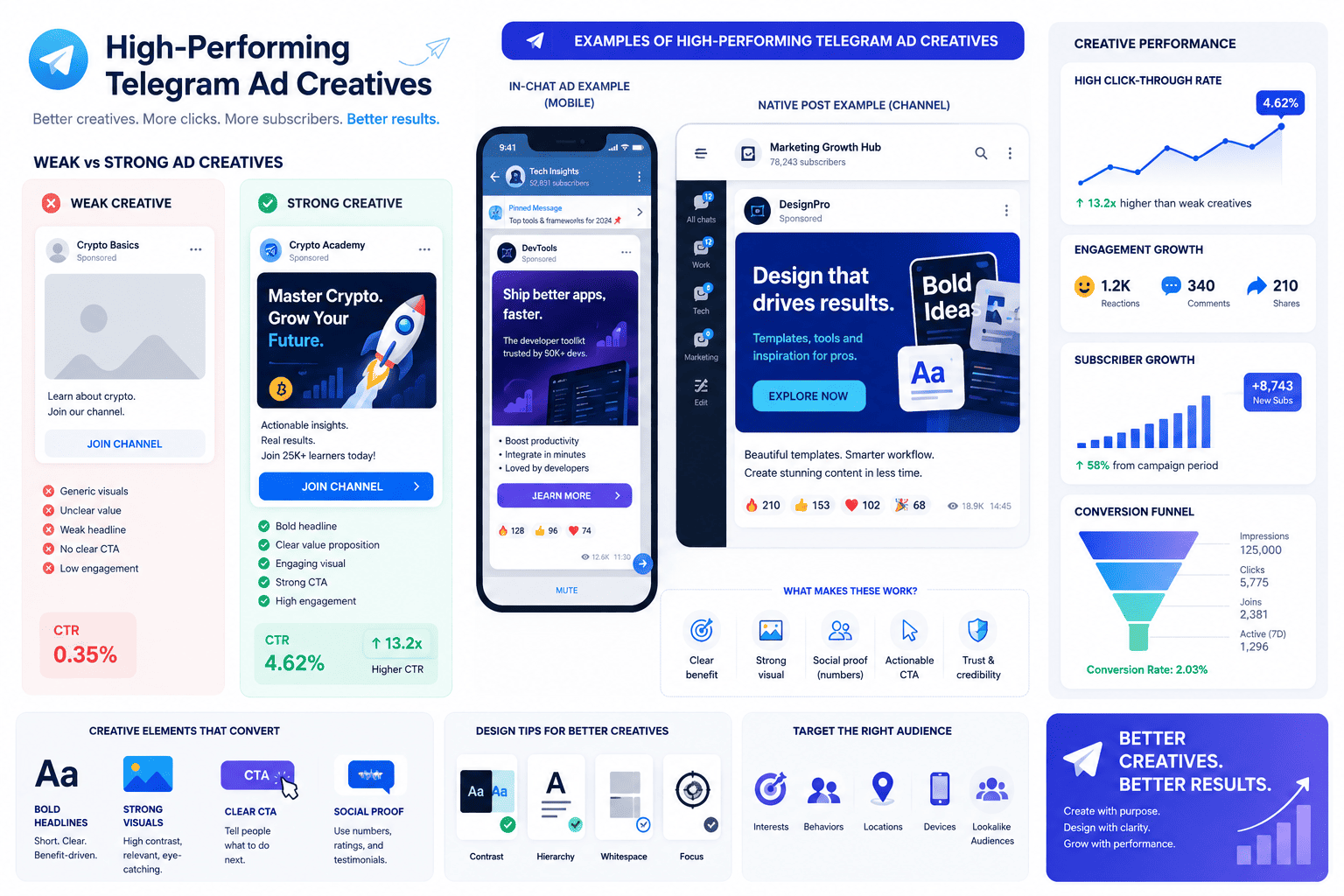
Telegram ads usually perform best when the message feels clear and natural.
Telegram uses short native ads, including 160-character ads, so brands do not have space for long explanations.
Most strong campaigns focus on one idea instead of trying to say too much at once.
Many campaigns focused on Telegram marketing solutions also test different versions of ads to compare:
- Headlines
- CTA wording
- Offer types
- Audience reactions
Different audiences respond to different messaging styles.
Some common ad approaches include:
- Problem-solving messages
- Social proof
- Limited offers
- Subscriber benefits
- Time-sensitive promotions
Good Telegram ads also match the tone of the community. A crypto audience may respond to language that feels very different from what SaaS founders or ecommerce buyers prefer.
Brands also improve tracking by keeping campaigns simple. One ad usually connects to one destination.
That structure makes reporting easier and helps teams understand what is producing results.
Examples of common Telegram CTAs include:
- Join the channel
- Start the bot
- Claim the promo code
- Access updates
- View the launch
Weak ads often fail because they sound too generic or too promotional.
Common Telegram Ad Copy Mistakes
- Weak hooks
- Multiple CTAs
- Generic branding language
- Sending traffic to poor channels
- Skipping creative testing
Destination quality matters too. If users join a Telegram channel that looks inactive or empty, many leave quickly.
Why Do Telegram Ad Campaigns Fail Early?
Most Telegram campaigns struggle early because brands guess placements, ignore audience quality, and increase budgets before testing performance properly.
Some advertisers managing Telegram ads alone focus too heavily on impressions while paying less attention to conversion quality and retention. That can lead to weak engagement and wasted ad spend.
A common rule in Telegram advertising is “one ad, one channel.” Sending users to multiple destinations inside one campaign makes optimization harder and weakens attribution tracking.
Brands also run into problems when they choose placements based only on subscriber count. Large Telegram channels do not always produce strong CTR if the audience is not relevant.
Other common campaign problems include:
- Weak channel positioning
- Poor audience targeting
- Scaling too early
- Weak analytics setup
- Low-quality landing pages
- Inconsistent customer support flows
Telegram also offers lighter built-in analytics compared with some larger ad platforms. Because of that, many brands combine Telegram data with CRM tools, external tracking software, and marketing automation systems.
Poor testing habits create another issue. Some advertisers scale campaigns before checking subscriber quality, which can increase acquisition costs very quickly.
Before increasing ad spend, brands usually benefit from smaller testing cycles and controlled experiments.
Reddit-Style Operational Lessons Brands Ignore
- “Mini-experiment” testing
- Strict pause rules
- Small-budget validation
- Placement-by-placement optimization
Many Reddit discussions about Telegram Marketing focus less on hype and more on testing discipline, budget control, and fast optimization decisions.
How Should Brands Structure Telegram Campaign Testing?
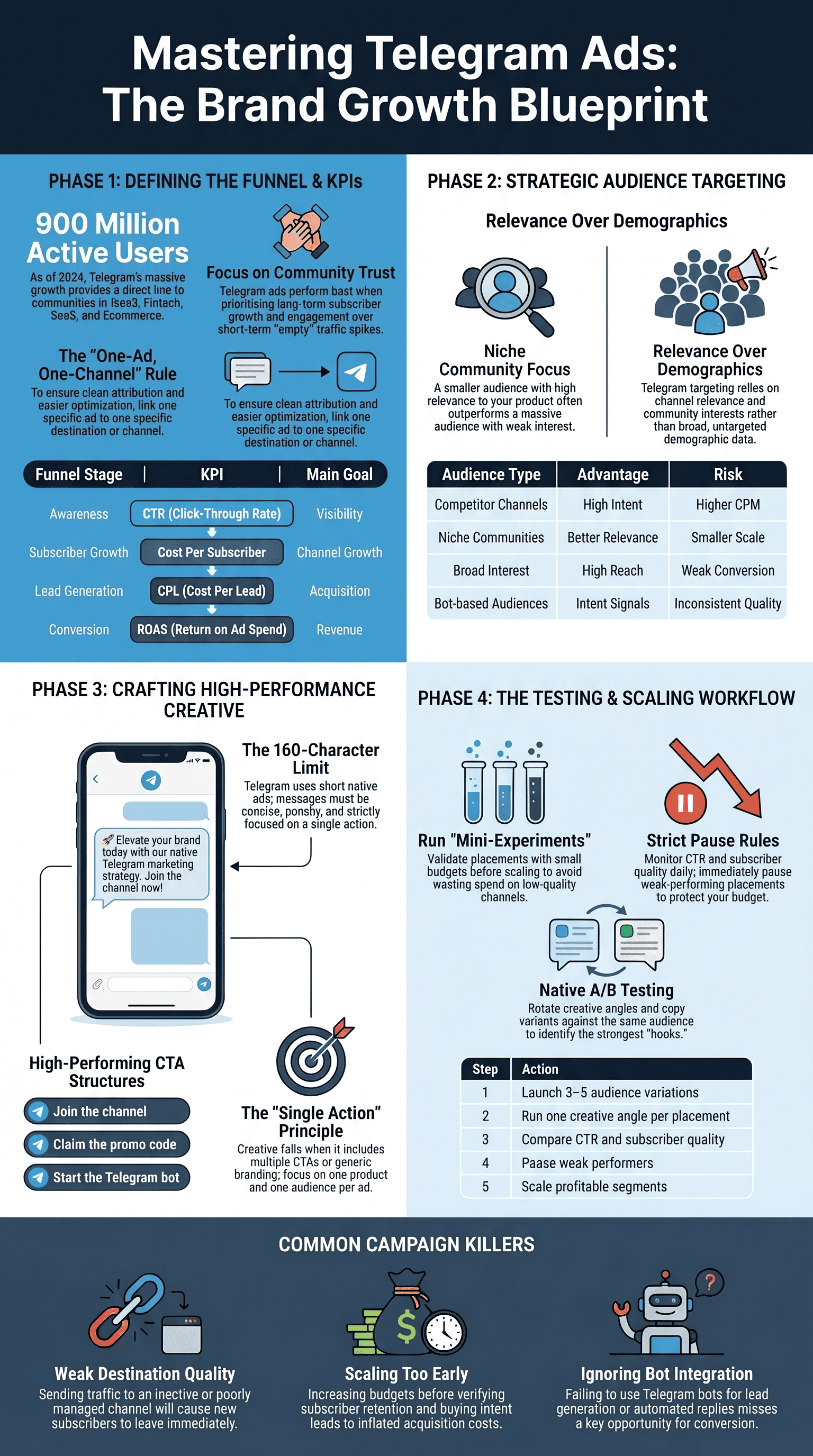
Telegram testing usually works best when brands isolate one audience, one message, and one destination at a time.
Simple campaign structures make optimization easier. One audience segment combined with one creative angle gives cleaner performance data and clearer reporting.
Many brands use structured A/B testing schedules to rotate creatives, placements, and CTA formats over time.
A practical testing workflow often looks like this:
- Define one audience category
- Launch one creative angle
- Assign one destination
- Monitor CTR and subscriber quality
- Pause weak performers quickly
- Scale profitable placements
Daily optimization also matters because Telegram engagement can shift quickly as audiences react to repeated content.
Most brands keep testing budgets small at the beginning. Instead of launching one large campaign immediately, many agencies run several smaller campaigns first. This lowers risk and helps teams learn faster.
Insights from Business of Apps indicate
"The first strategy focused on building community engagement and trust before encouraging users to purchase. By prioritizing trust and community before making a sales pitch, this strategy established a more organic conversion funnel. It led to higher-quality leads and lower acquisition costs. From the comparison, it's clear that the first strategy [sending traffic to a Telegram group/channel] was far more cost-efficient, generating more conversions at a significantly lower CPA [compared to sending traffic straight to an external website]." - Business of Apps
Strong Telegram Ads workflows also rely on steady reporting. Campaign managers usually review CTR, cost per subscriber, retention, and conversion quality before increasing spend.
A Practical Telegram Testing Workflow
- Launch 3–5 audience variations
- Run one creative angle per placement
- Compare CTR and subscriber quality
- Pause weak performers
- Scale profitable segments
This process helps brands improve optimization while reducing wasted spend on low-quality placements.
How Much Budget Should Brands Allocate To Telegram Ads?
Telegram budget planning usually works best when brands focus on testing first, then scale only after they understand subscriber quality and conversion performance.
Budget size in Telegram Ads often depends on placement competition, channel quality, and targeting accuracy. Many brands begin with smaller campaigns before increasing spend.
According to Telegram Ads Agency, minimum campaign budgets can start around $200 for direct ads and about $500 for official Telegram Ads campaigns. Some campaign setups may also use TON for funding and payments.
Early campaign budgets are often used for:
- Audience validation
- Placement quality testing
- Creative testing
- Subscriber quality analysis
- Conversion tracking
Scaling too quickly can create problems because some channels generate low-cost subscribers with weak engagement or low buying intent.
Brands also need to plan for extra costs tied to analytics tools, CRM systems, customer support automation, and creative updates. Subscriber growth alone does not always lead to stronger revenue results.
What Does A High-Performing Telegram Advertising Plan Include?
Strong Telegram advertising plans usually combine audience research, creative testing, and ongoing optimization tied to clear KPIs.
Most professional Telegram campaigns follow structured systems instead of random ad placements. Many Telegram Ads Agency workflows focus on reporting, testing, optimization, and campaign organization from the beginning.
A high-performing Telegram advertising plan often includes:
- Defined campaign objective
- Channel and competitor research
- One message per ad
- Multiple copy variants
- Structured A/B testing
- Reporting cadence
- Scaling rules
- Destination quality review
KPI tracking
- Audience segmentation
- Conversion analysis
- Continuous optimization
Strong campaign plans also separate awareness campaigns from conversion campaigns. This makes reporting cleaner and helps brands understand which campaigns are driving real results.
The strongest Telegram campaigns usually treat Telegram channels as long-term audience assets instead of short-term traffic sources.
FAQ
How do Telegram Ads help brands increase brand awareness?
Telegram Ads help brands reach a large target audience through active Telegram channels and broadcast channels. Many people use Messaging Apps every day, so businesses can share updates, offers, and news quickly.
Strong advertising campaigns use clear ad formats and simple messages that people understand fast. A good Telegram Marketing plan can improve engagement rates, support community building, and help brands grow their Digital marketing results over time.
Which content formats work best for Telegram Marketing campaigns?
The best content formats for Telegram Marketing include Sponsored posts, short videos, polls, and Native Ads. These formats keep users interested and encourage more native interaction inside Telegram channels.
Many brands also use Telegram bots and Telegram Mini Apps to improve user experience and increase content consumption. Strong marketing strategies focus on useful information, clear messages, and regular updates instead of pushing sales in every post.
Why do businesses use Telegram bots for customer support?
Businesses use Telegram bots because they help improve customer service and Customer Care without needing staff online all day. Bots can answer common questions, send automatic replies, and share a promo code or discount code within seconds.
Some companies connect Telegram bots with CRM systems and marketing automation tools to manage customer support more efficiently. Fast support and helpful replies can improve engagement rate and build stronger customer trust.
How can brands protect user data during Telegram advertising campaigns?
Brands can protect user data by following strong privacy policies and secure Digital marketing practices. Telegram messenger supports end-to-end encryption in many private chats, which helps keep conversations safer.
Businesses should only request a phone number when it is necessary for customer support or account access. Companies should also use secure digital tools, reliable information technology infrastructure, and protected data center systems to reduce security risks and protect customer information.
What should brands prepare before launching a Telegram ad campaign?
Before launching an ad campaign, brands should identify their target audience and set clear goals for their marketing campaigns. Businesses should also choose the right Telegram channels, ad formats, and advertising platforms for their message.
Some companies test automatic campaigns, mobile app ads, and mini apps to improve engagement rates and content consumption. Careful strategic marketing planning helps businesses increase brand awareness and build stronger online communities over time.
Why Telegram Advertising Keeps Growing for Brands
Telegram keeps growing because brands want better engagement and more control over how they reach people. It’s a simple way to build direct connections without fighting crowded feeds or changing algorithms.
Still, growth doesn’t happen automatically. Brands that test often, keep messages short, and focus on real results usually see stronger long term performance.
Good Telegram campaigns also depend on what happens after the click. That’s where support from Telegram Ads Agency can help. They help brands grow subscribers, improve campaign performance, and track results with clear reporting. If you want a more reliable way to grow on Telegram, it’s a smart next step.
References
- https://yougov.com/en-us/articles/51426-exploring-telegrams-growing-user-base-and-advertising-potential
- https://www.businessofapps.com/insights/the-telegram-ads-playbook-for-token-presales/
Related Articles